
Everything You Need To Know About Autoflowering Cannabis
Autoflowering cannabis has transformed home growing by making it faster, easier, and more beginner-friendly than ever before. Unlike traditional photoperiod strains, autoflowers switch from vegetative growth to flowering automatically, without needing changes in light cycles.
Modern autoflower strains are far more potent and productive than early versions, making them a serious option for both new and experienced growers.
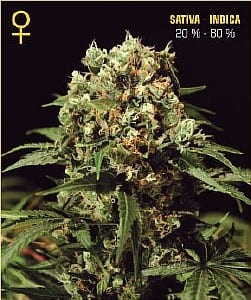
What Is Autoflowering Cannabis?
Autoflowering cannabis is descended from wild Cannabis ruderalis populations found in Eastern Europe, Russia, China, and Central Asia. These plants evolved in harsh climates with short summers, which led them to develop the ability to flower based on age rather than daylight hours.
Botanists still debate whether C. ruderalis is:
- A species in its own right
- A subspecies of Cannabis indica
- A subspecies of Cannabis sativa
Regardless of classification, ruderalis genetics are what give autoflowers their automatic flowering trait.
Why Are Autoflower Strains So Popular?
The popularity of autoflowering strains has exploded in recent years thanks to modern breeding improvements.
Today’s autoflowers offer:
✔ Faster harvests
✔ Smaller, more discreet plants
✔ No need to manage light cycles
✔ Improved potency compared to early autoflowers
✔ Excellent resilience for beginners
It’s now possible to grow high-quality harvests in as little as 9–10 weeks from seed to harvest, making autoflowers one of the quickest ways to grow cannabis.
Autoflower Plant Size & Structure
Autoflowers tend to stay short and compact, which makes them ideal for:
- Small grow tents
- Balconies
- Stealth outdoor grows
Typical characteristics include:
- Height usually 40–90 cm
- One dominant main cola
- Several smaller side branches
- Dense but smaller buds compared to large photoperiod plants
Leaves can be either narrow or wide, but many ruderalis-based plants display thinner, sativa-like leaves.
Autoflower Growth Timeline
One of the biggest advantages of autoflowers is their predictable and rapid life cycle.
Typical Timeline
- Germination → Vegetative growth: Days 1–14
- Automatic flowering begins: Around days 14–21
- Seed to harvest: Usually 8–10 weeks, sometimes as fast as 6.5–7 weeks for ultra-fast strains
Because flowering is age-dependent, growers cannot extend the vegetative stage like they can with photoperiod plants.
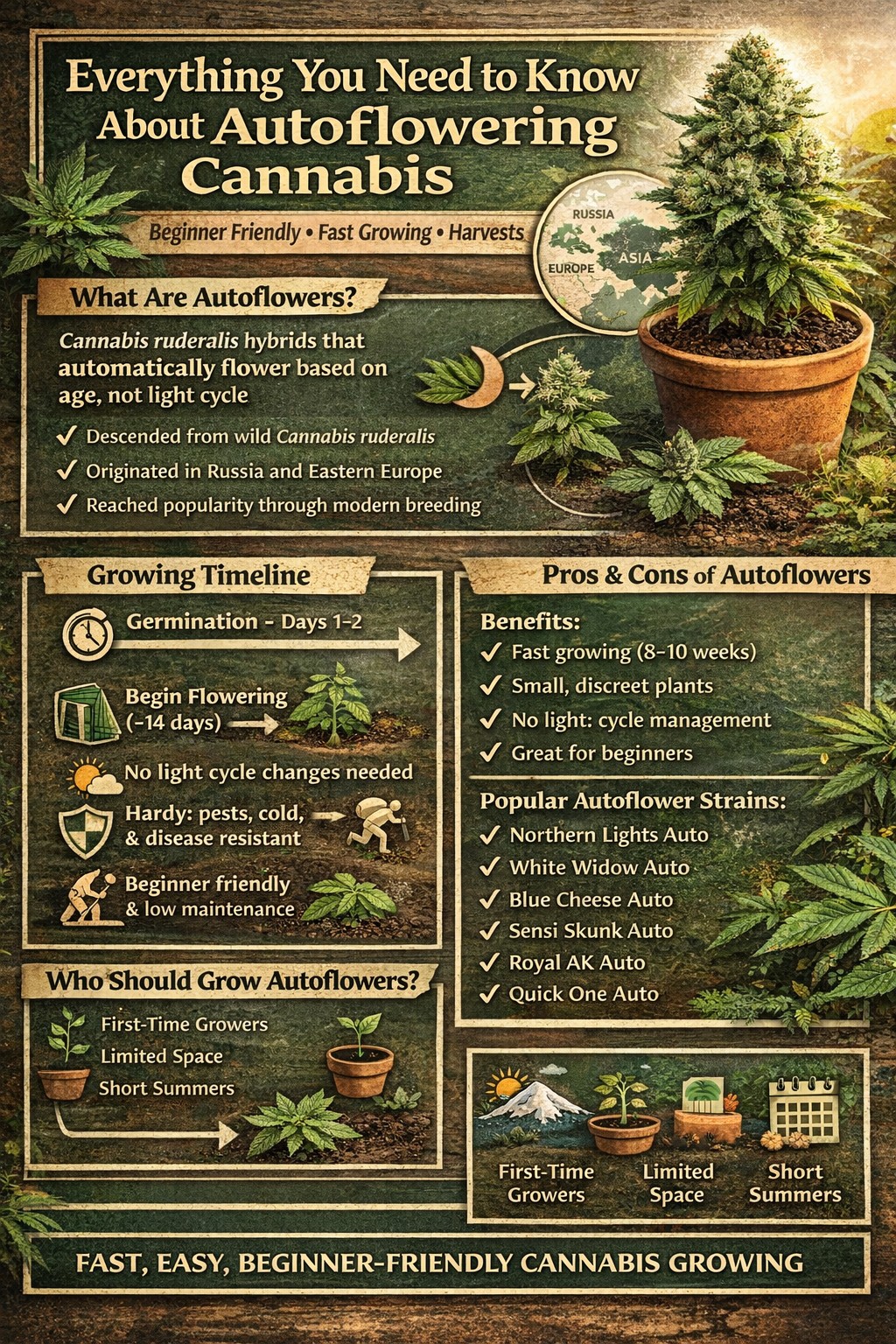
Are Autoflowers Easier to Grow?
Yes — autoflowers are widely considered beginner-friendly.
They are often:
- Resistant to pests
- Tolerant of colder temperatures
- More resilient to disease
- Capable of growing in less-than-perfect soil
However, their short life cycle means mistakes (overwatering, nutrient burn, stress) have less time to be corrected, so gentle care is still important.
Lighting for Autoflowering Cannabis
Autoflowers do not require changes in light schedules to start flowering, but lighting can still influence growth and yield.
Many growers use:
- 18–20 hours of light per day for the entire life cycle
- Some run 24 hours of light, though results vary
Light Spectrum Tips (Grower Reports)
While not essential, some growers believe:
- Blue spectrum light during early growth can encourage bushier development
- Red spectrum light later in flowering may help boost bud production
These methods are optional but can be experimented with by more advanced growers.
Pros and Cons of Autoflower Strains
Advantages
✔ Very fast harvests
✔ No light cycle management
✔ Small, discreet plants
✔ Great for beginners
✔ Can be grown outdoors in short summers
Disadvantages
✖ Smaller yields per plant compared to large photoperiod plants
✖ Limited time to fix growth problems
✖ Cannot control plant size by extending veg time
Popular Autoflower Strains
Some well-known strains available in autoflower versions include:
- Sensi Skunk Auto
- Northern Lights Auto
- White Widow Auto
- Blue Cheese Auto
- Royal AK Auto
- Quick One Auto
These strains combine classic genetics with the speed and convenience of autoflowering traits.
Are Autoflowers Less Potent?
Early autoflowers were often weaker, but modern breeding has changed that. Many current autoflower strains now produce THC levels comparable to photoperiod strains, making them a legitimate option for quality and potency.

Who Should Grow Autoflowers?
Autoflowers are ideal for:
🌱 First-time growers
🌱 People with limited space
🌱 Growers wanting quick harvests
🌱 Outdoor growers in cooler climates
🌱 Anyone wanting multiple harvests per season
Autoflowering Cannabis FAQs
Do autoflowers need 12/12 light to flower?
No. They flower automatically based on age, not light cycle.
How long do autoflowers take from seed to harvest?
Most finish in 8–10 weeks, with some ultra-fast strains finishing even sooner.
Can I clone an autoflower plant?
Cloning is not recommended. Clones will be the same biological age as the mother plant and will flower immediately.
Do autoflowers yield less?
Per plant, usually yes — but fast turnaround times can make up for it.