
Chamonix is unlike most French ski resorts. It’s a proper mountain town, sitting beneath the enormous peaks of the Mont Blanc massif, with a history built around mountaineering rather than package ski holidays.
The streets are filled with climbing shops, restaurants, bars and people from all over the world. In winter, skiers and snowboarders arrive for the famous mountain terrain. During summer, climbers, trail runners and hikers take over.
With that international atmosphere, visitors naturally ask questions about cannabis in Chamonix. Is weed legal? Is there a cannabis scene? Can tourists buy hashish? What about CBD shops, police enforcement and crossing the nearby Swiss or Italian borders?
Cannabis in Chamonix: Quick Facts
| Topic | Information |
|---|---|
| Location | Chamonix-Mont-Blanc, Haute-Savoie, France |
| Town altitude | Approximately 1,035 metres |
| Recreational cannabis | Illegal |
| Hashish containing controlled THC | Illegal |
| Standard drug-use fixed fine | €500 |
| Reduced / increased fine | €400 / €1,000 |
| Weed availability | Telegram shops and street dealers |
| Cannabis prices | 8 – 12 euro per gram |
| CBD | Qualifying products can be sold legally |
| Main ski areas | Brévent–Flégère, Grands Montets, Balme, Les Houches |
| Local atmosphere | International mountaineering town |
| Nearby borders | Switzerland and Italy |
| Tourism seasons | Winter skiing and summer mountain sports |
Is Weed Legal in Chamonix?
No. Recreational cannabis is illegal in Chamonix under French law.
That applies whether you’re visiting for a weekend, working a winter season, staying in a mountain hostel or renting a private chalet.
France operates a fixed-fine procedure for certain drug-use offences, including qualifying cases involving small amounts of cannabis.
As of October 2026, the standard fixed fine is €500. It is reduced to €400 if paid within 15 days and increased to €1,000 if unpaid after 45 days.
However, this does not mean cannabis has been legalised or decriminalised.
Can You Smoke Weed in Public in Chamonix?
No. Recreational cannabis consumption is illegal in public spaces throughout Chamonix.
That includes the town centre, pedestrian shopping streets, public parks, lift stations and mountain areas.
The same law applies whether you’re near Place Balmat, the Aiguille du Midi cable car or a quieter area outside town.
What About Hotels, Hostels and Chalets?
Private accommodation does not create an exemption from French drug laws.
Hotels, hostels, holiday apartments and chalets may also have their own smoking restrictions.
Are Police Strict About Cannabis in Chamonix?
Chamonix is subject to French national drug legislation.
The town’s mountain culture does not change the law.
Where To Buy Weed in Chamonix?
Telegram Encrypted Messaging App
Looking for a fast, private, and easy way to order cannabis? Telegram has become one of the most popular platforms for trusted automated shops, letting customers browse products, place orders, and receive updates—all within the app.
Why customers choose Telegram Shops:
- 🔒 Private, encrypted messaging
- ⚡ Quick ordering in just a few taps
- 🤖 Automated shop available 24/7
- 📦 Order tracking and instant updates
To make sure you reach the correct shop, use VertBoyz_bot. Searching for “VertBoyz” in Telegram may show unofficial profiles, groups, or similarly named accounts, so using the direct VertBoyz_bot link is the easiest way to access the official automated shop.
Tap the VertBoyz_bot link below to open the official Telegram shop, see the current menu, and place your order in just a few taps.
Visit The VertBoyz_bot Cannabis Shop.
What Makes Chamonix Different From Other French Ski Resorts?
Chamonix’s identity comes from the mountains surrounding it.
The town sits beneath Mont Blanc, the highest mountain in the Alps, and has been an international centre for mountaineering for centuries.
In 1786, Jacques Balmat and Michel-Gabriel Paccard completed the first recorded ascent of Mont Blanc.
That achievement helped establish Chamonix as a major destination for climbers and mountain explorers.
Chamonix also hosted the first Winter Olympic Games in 1924.
Unlike a purpose-built resort such as Val Thorens, Chamonix has a substantial permanent community and operates throughout the year.
This gives it a different social atmosphere from destinations built almost entirely around winter tourism.
Understanding Chamonix: The Main Areas of Town and Valley
One important distinction is that Chamonix refers both to the town itself and, in everyday travel discussions, the wider Chamonix Valley.
The ski areas and surrounding settlements are spread along the valley rather than concentrated around a single resort centre.
Choosing where to stay can therefore make a major difference to your holiday.
Chamonix Town Centre: Restaurants, Shops and Nightlife
Central Chamonix is the busiest part of the valley.
The pedestrian streets around Rue du Docteur Paccard and Place Balmat contain shops, cafés, restaurants and bars.
The town has a mixture of traditional Alpine buildings, hotels and modern businesses catering to international visitors.
Staying centrally is convenient for anyone who wants to explore the nightlife or spend time in town without driving.
The railway station and several transport connections are also within walking distance of central accommodation.
Unlike many ski resorts, Chamonix town centre remains lively outside the winter season.
Les Praz: A Quieter Base Near La Flégère
Les Praz lies northeast of central Chamonix.
It’s a quieter residential and tourist area with traditional chalets, hotels and mountain views.
The La Flégère cable car provides access to the ski area above the village.
Les Praz can appeal to visitors who want convenient mountain access without staying in the busiest part of Chamonix.
The village is also served by the Mont Blanc Express railway.
For visitors interested in skiing, walking and a more relaxed evening atmosphere, it offers a useful alternative to the town centre.
Argentière: The Gateway to Grands Montets
Argentière is one of the most important settlements in the upper Chamonix Valley.
Located approximately eight kilometres from central Chamonix, it has its own shops, restaurants and accommodation.
Argentière is particularly associated with the Grands Montets ski area, which has a reputation for demanding terrain and freeride skiing.
The village attracts experienced skiers and mountain enthusiasts, although families and less experienced visitors also stay here.
Its atmosphere is generally smaller and quieter than central Chamonix.
Transport connections make it possible to visit the town without driving.
Les Houches: Family Skiing and Traditional Villages
Les Houches lies southwest of Chamonix.
It’s an established mountain community with its own ski area, accommodation and village facilities.
The local skiing includes wooded terrain and pistes suitable for different ability levels.
Les Houches is also associated with the Kandahar downhill course, used for major alpine skiing competitions.
For families and visitors looking for a quieter base, Les Houches can be attractive.
However, it is a separate village rather than a neighbourhood within walking distance of central Chamonix.
Le Tour: A Small Village Near the Swiss Border
Le Tour is a small settlement towards the upper end of the valley.
It provides access to the Balme ski area and is surrounded by dramatic mountain scenery.
The village has a quieter atmosphere than central Chamonix, with accommodation geared towards skiing and outdoor activities.
Its location can be particularly convenient for visitors focusing on the Balme sector.
However, those planning regular evenings in central Chamonix should check transport arrangements carefully.
Vallorcine: The Far End of the Valley
Vallorcine lies close to the Swiss border, beyond the Col des Montets.
It’s a small mountain community with access to the Balme ski area and the Mont Blanc Express railway.
The village offers a peaceful alternative to central Chamonix.
Its location is particularly appealing to visitors who prefer a quieter environment and easy access to mountain activities.
However, staying in Vallorcine requires more planning if you want to visit Chamonix’s nightlife regularly.
Après-Ski and Nightlife in Chamonix
Chamonix has a more varied nightlife scene than many French ski resorts.
Because it’s a functioning town rather than a single-purpose ski station, visitors can find everything from traditional restaurants and relaxed pubs to live music and late-night venues.
The town centre is the main focus of evening entertainment.
Chambre Neuf: A Familiar Après-Ski Name
Chambre Neuf is one of Chamonix’s best-known après-ski bars.
Located close to the railway station, it has long been associated with live music and a lively atmosphere after skiing.
Its central location makes it convenient for visitors returning from different parts of the valley.
Seasonal programmes and opening hours should be checked before visiting.
La Folie Douce Hotel: Entertainment in Town
La Folie Douce Hotel Chamonix combines accommodation, dining and entertainment in a historic hotel building.
Unlike the mountain-based La Folie Douce venues found in some other French ski resorts, this location is in Chamonix itself.
That makes it accessible to visitors who aren’t skiing.
The venue’s programme can include music, dining and evening events.
Traditional Bars and Mountain Restaurants
Chamonix also has a wide selection of smaller bars, restaurants and cafés.
Some cater to international visitors, while others have a more traditional French atmosphere.
The town’s year-round population means nightlife doesn’t disappear completely when the ski season ends.
During summer, outdoor terraces become particularly popular with climbers, hikers and trail runners returning from the mountains.
Does Chamonix’s Nightlife Mean Cannabis Is Tolerated?
No.
A lively bar or international crowd does not change French cannabis laws.
CBD in Chamonix: Legal Products and Restrictions
CBD, or cannabidiol, is regulated differently from recreational cannabis in France.
Qualifying CBD products may be sold legally when they comply with applicable French and European regulations.
The rules depend on product type, THC content, ingredients and intended use.
The commonly cited 0.3% THC threshold does not mean that every product labelled CBD is automatically legal.
Chamonix and the Swiss Border: Important Cannabis Differences
Chamonix is relatively close to Switzerland, and the Mont Blanc Express railway continues through the valley towards Martigny.
However, Switzerland and France have different cannabis regulations.
Visitors should not assume that rules applying to certain cannabis products in Switzerland also apply in France.
Transporting cannabis across an international border can create additional legal consequences.
The same applies to travel between France and Italy through the Mont Blanc Tunnel.
A product’s legal status in one country does not automatically make it legal to import into another.
For visitors planning cross-border journeys, checking the current laws in each country is essential.
Skiing in Chamonix: Five Main Areas
Chamonix’s skiing is organised differently from resorts such as Méribel or Courchevel.
Instead of one large, continuously connected ski network, the valley contains several distinct ski areas.
Visitors often use buses, trains or other transport to move between them.
Brévent: Skiing Above Chamonix
The Brévent ski area rises directly above Chamonix town.
It offers dramatic views towards Mont Blanc and a mixture of pistes for different abilities.
The Planpraz gondola provides access from the town side.
Brévent is particularly convenient for visitors staying in central Chamonix.
La Flégère: Sunny Slopes and Mountain Views
La Flégère is accessed from Les Praz.
It offers skiing with impressive views of the Mont Blanc massif.
Brévent and Flégère are connected within the same ski sector, allowing visitors to explore both without returning to the valley floor when the relevant lifts are operating.
Grands Montets: Challenging Terrain Above Argentière
Grands Montets is one of Chamonix’s most famous ski areas.
Located above Argentière, it has a reputation for steep terrain, high-altitude skiing and freeride opportunities.
It attracts experienced skiers and snowboarders, although the available marked pistes vary in difficulty.
Visitors should check the current lift configuration and operating areas before travelling.
Balme: Le Tour and Vallorcine
The Balme ski area is accessible from Le Tour and Vallorcine.
It offers a different mountain environment from Grands Montets, with open slopes and views towards the surrounding peaks.
Its location near the Swiss border makes it a distinctive part of the Chamonix Valley.
Les Houches: Wooded Slopes and Family Skiing
Les Houches has its own ski area southwest of Chamonix.
Its wooded terrain can provide a different skiing experience from the more exposed high-altitude sectors.
The area is popular with families and visitors seeking a range of marked pistes.
It is also associated with the Kandahar downhill course.
Aiguille du Midi and the Vallée Blanche
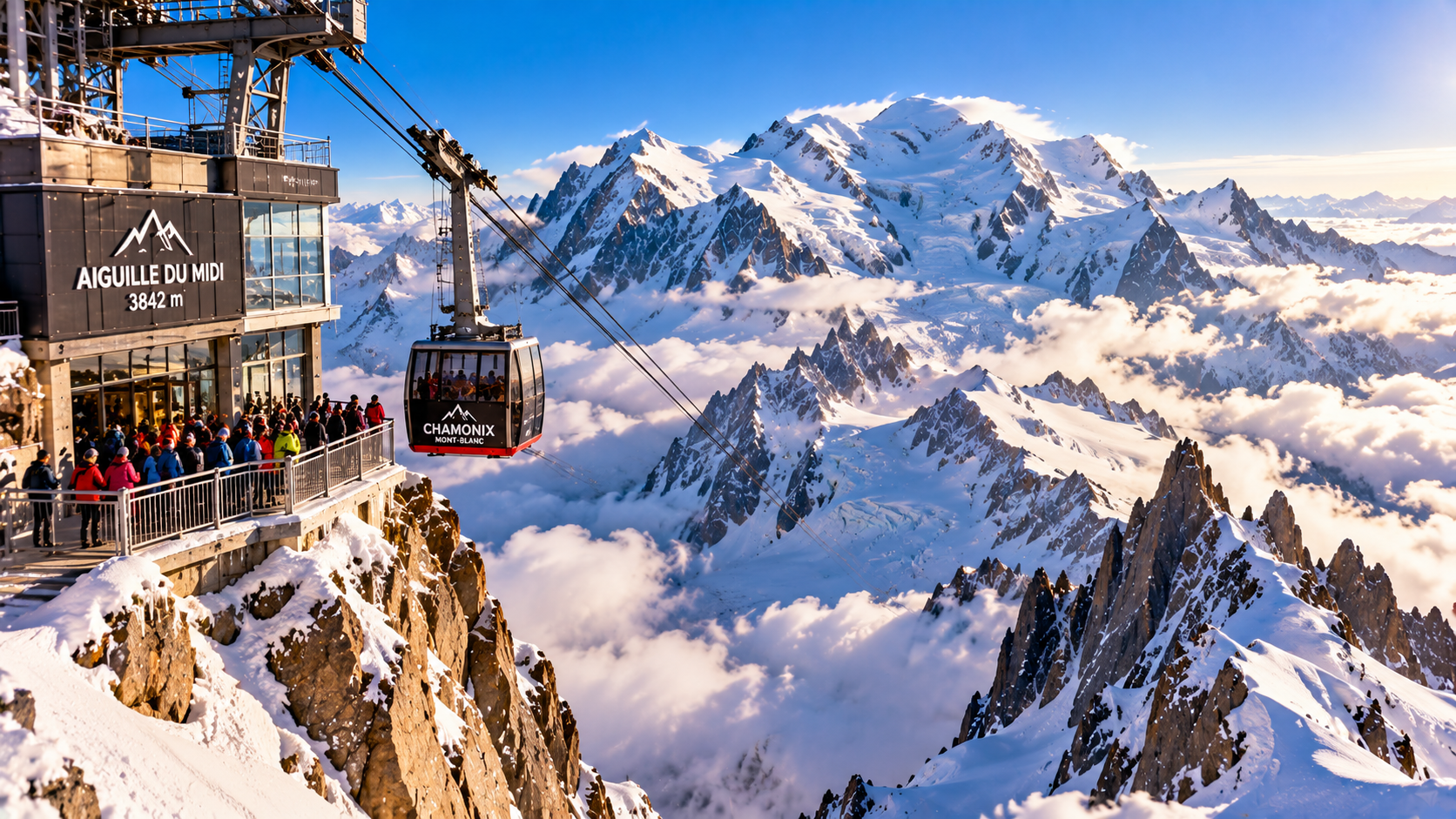
One of Chamonix’s most famous attractions is the Aiguille du Midi cable car.
It takes visitors high into the Mont Blanc massif, reaching an altitude of approximately 3,842 metres.
The experience is very different from an ordinary ski lift.
Visitors encounter a high-mountain environment with extraordinary views, exposed terrain and significantly reduced oxygen availability compared with the valley floor.
The cable car is popular with sightseers as well as mountaineers.
What Is the Vallée Blanche?
The Vallée Blanche is a famous high-mountain ski itinerary descending through glaciated terrain.
It is not an ordinary marked, secured ski piste.
The route involves serious hazards, including crevasses, avalanches and rapidly changing weather.
Skiers need appropriate equipment, experience and conditions. Hiring a qualified high-mountain guide is strongly recommended.
The Vallée Blanche should never be treated as a casual extension of a resort ski day.
Cannabis, Altitude and Mountain Safety
Cannabis containing THC can impair coordination, judgement, attention and reaction time.
Chamonix attracts visitors undertaking activities where mistakes can have severe consequences.
Skiing, climbing, mountaineering and glacier travel all require concentration and sound decision-making.
Why High Altitude Matters
Chamonix town sits at approximately 1,035 metres, but visitors can travel rapidly to elevations above 3,000 metres.
At those heights, the reduced availability of oxygen can cause headaches, dizziness, nausea and fatigue.
Some visitors may develop altitude sickness.
Mountain Weather Can Change Quickly
Weather in the Mont Blanc massif can change rapidly.
Strong winds, snowfall, poor visibility and falling temperatures can create dangerous conditions.
Always check the forecast and relevant avalanche information before heading into the mountains.
Chamonix Ski Season 2026/27
Chamonix’s different ski areas have separate opening schedules.
The official tourism office has published the following provisional opening dates for winter 2026/27.
| Ski area | Planned opening |
|---|---|
| Grands Montets | 28 November 2026 |
| La Flégère | 28 November 2026 |
| Brévent | 12 December 2026 |
| Balme–Vallorcine | 12 December 2026 |
| Les Houches–Saint-Gervais | 19 December 2026 |
All dates are subject to snow, weather and operating conditions.
The opening of one ski area does not mean the entire Chamonix Valley network is operational.
November and December: Early Winter
Some high-altitude areas may open in late November if conditions allow.
The main winter season builds through December, with Christmas and New Year bringing increased visitor numbers.
Early-season travellers should check the live snow report before planning specific ski days.
January and February: Main Winter Conditions
January and February are important months for skiing and snowboarding.
The valley’s different elevations and slope orientations can create substantial differences in snow conditions.
February is also busy because of European school holidays.
March and April: Spring Skiing
Longer daylight hours bring a different atmosphere to Chamonix.
The higher ski areas can remain attractive for winter sports while conditions at valley level become milder.
Late-season lift operations vary by ski area.
Visitors should check official closing dates and live conditions rather than assuming every sector remains open.
Chamonix in Summer: Climbing, Hiking and Trail Running
Chamonix is one of the few major Alpine destinations where summer can feel just as important as winter.
The town attracts climbers, hikers, mountain bikers and trail runners from around the world.
The Mont Blanc massif provides access to an enormous range of mountain activities.
The Tour du Mont Blanc
The Tour du Mont Blanc is one of Europe’s best-known long-distance hiking routes.
It passes through France, Italy and Switzerland, circling the Mont Blanc massif.
Many hikers use Chamonix as a starting point or transport base.
Trail Running and UTMB
Chamonix is closely associated with the Ultra-Trail du Mont-Blanc, commonly known as UTMB.
The event attracts elite trail runners and large numbers of spectators.
During major event periods, the town can become extremely busy.
Mountaineering and Alpine Climbing
Chamonix remains an internationally important centre for mountaineering.
Climbers visit for routes ranging from relatively accessible rock climbs to serious high-altitude expeditions.
The surrounding mountains demand appropriate training, equipment and judgement.
This strong summer identity is one of the main reasons Chamonix feels different from resorts built primarily around skiing.
Getting Around Chamonix Without a Car
Chamonix has an extensive transport network connecting the town with other settlements along the valley.
This is particularly important because its ski areas are spread across different locations.
Mont Blanc Express Train
The Mont Blanc Express railway runs through the valley, linking Chamonix with settlements including Les Houches, Les Praz, Argentière and Vallorcine.
The line also continues towards Switzerland.
For visitors staying outside central Chamonix, the train can be a useful way to reach different parts of the valley.
The local Carte d’Hôte provides access to eligible train journeys between Servoz and Vallorcine under the applicable conditions.
Visitors should check the current timetable and ticket rules.
Chamonix Valley Buses
Chamonix Mobilité operates bus services across the valley.
Routes connect important residential areas, tourist destinations and ski access points.
Unlike some resorts with completely free shuttle networks, Chamonix has ticketing rules that depend on the service and passenger eligibility.
Visitors should check the current fares and transport entitlements rather than assuming every bus is free.
Getting to Chamonix From Geneva
Geneva Airport is a major international gateway for Chamonix.
Visitors commonly use shared transfers, private transport or rental cars.
Road travel times depend on traffic, weather and seasonal demand.
Chamonix is also accessible by rail through connections at Saint-Gervais-les-Bains–Le Fayet.
Chamonix vs Other French Ski Resorts
Chamonix is often compared with Tignes, Val Thorens and Méribel, but the skiing experience is fundamentally different.
Chamonix is a mountaineering town with several separate ski areas, dramatic high-mountain terrain and a strong year-round outdoor community.
Tignes is a high-altitude ski resort connected with Val d’Isère, offering a more integrated lift network.
Val Thorens is a purpose-built resort within Les 3 Vallées, known for high-altitude skiing and energetic après-ski.
Méribel sits in the centre of Les 3 Vallées, making it convenient for exploring a large interconnected ski area.
Visitors prioritising easy movement between hundreds of kilometres of pistes may prefer Les 3 Vallées.
Those attracted by mountaineering history, dramatic scenery and a genuine mountain-town atmosphere may find Chamonix more appealing.
The cannabis laws remain the same throughout France.
Frequently Asked Questions About Cannabis in Chamonix
Is weed legal in Chamonix in 2026?
No. Recreational cannabis remains illegal under French law.
Can tourists legally buy cannabis in Chamonix?
No. France has not established a legal recreational cannabis retail market in Chamonix.
How much does weed cost in Chamonix?
Standard EU prices of 8 – 12 euro per gram.
Is hashish legal in Chamonix?
No. Recreational hashish containing controlled THC is illegal in France.
Is CBD legal in Chamonix?
Qualifying CBD products may be sold legally in France, subject to applicable product regulations and THC limits.
Can you bring cannabis from Switzerland to Chamonix?
Do not assume that a product permitted under Swiss rules can legally be brought into France. Crossing the border introduces separate import and customs considerations.
Does Chamonix have good nightlife?
Yes. Chamonix has a lively year-round social scene, including pubs, restaurants, live music and après-ski venues.
Is Chamonix a good place for beginners?
Yes, there are beginner-friendly ski areas and lessons available. However, Chamonix is particularly famous for demanding high-mountain terrain, so choosing the right ski sector matters.
Are all the Chamonix ski areas connected?
No. Several ski areas are separate and require transport between them.
Is the Vallée Blanche a normal ski piste?
No. It is an unmarked, unsecured high-mountain itinerary involving glacier hazards.
Is Chamonix good in summer?
Yes. Chamonix is a major destination for climbing, hiking, trail running and mountain sports.
Can you visit Chamonix without a car?
Yes. The Mont Blanc Express railway and local bus network connect much of the valley.
Final Thoughts: Cannabis and Visiting Chamonix
Chamonix stands apart from most French ski destinations.
Its mountaineering history, dramatic setting beneath Mont Blanc, international community and year-round outdoor culture give it an identity that extends far beyond skiing.
Visitors can explore lively town-centre streets, quiet mountain villages, demanding ski terrain and some of Europe’s most famous alpine attractions.
For anyone researching cannabis in Chamonix, the legal situation is straightforward: recreational weed remains illegal, and there is no reliable evidence supporting claims that tourists can buy or consume it without legal consequences.
Check out our 2026 guide covering everything you need to know about cannabis in France:
Everything You Need To Know About Cannabis In France
©2026 – Stoner Circle. All Rights Reserved.